Carry out Nonlinear Structural Analysis with Unmatched Accuracy

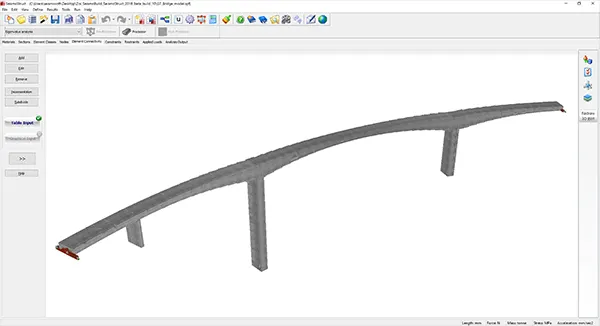
When you need to assess, analyse or retrofit buildings and structures under seismic or other loads — whether static or dynamic — SeismoStruct provides a powerful, reliable finite-element environment that captures realistic structural behaviour. It is the go-to solution for researchers, consultants structural engineers, and institutions seeking accurate, code-aware, nonlinear analysis of complex 3D structures—including irregular buildings, bridges, and foundation systems—taking into account both material inelasticity and geometric nonlinearities (P-Delta effects).

What SeismoStruct Offers

  • Nonlinear finite-element analysis (static or dynamic)

SeismoStruct predicts the large-displacement behaviour of space frames under static or dynamic loading, taking into account both material inelasticity (e.g. yielding, cracking) and geometric nonlinearities (P-delta effects, buckling).

  • Comprehensive set of analysis types

Methods include static linear analysis, nonlinear static (pushover) analysis, nonlinear dynamic (time-history) analysis, incremental dynamic analysis (IDA), response spectrum analysis, eigenvalue analysis and buckling analysis — covering almost all needs for seismic assessment and performance-based design.

  • Wide range of material and element models

Supports concrete, steel, masonry, FRP, and even shape-memory alloy (SMA) material models — plus a large library of 3D element types (beams, columns, infill panels, masonry walls, link elements, isolation devices, etc.) and a variety of pre-defined section types (steel, reinforced concrete, composite) for the structural representation.

  • Intuitive visual modelling interface

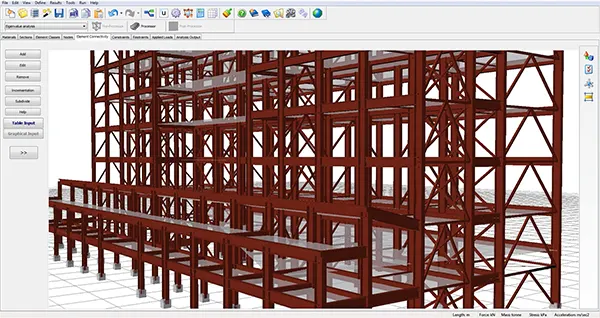
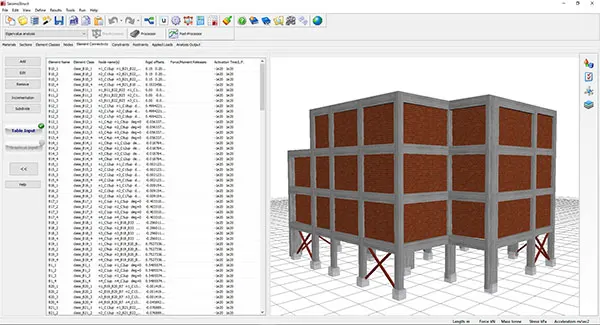
No need for scripts or manual configuration files — the interface is fully graphical. The “Building Modeller” and “Wizard” tools enable rapid creation of 2D or 3D models (with regular or irregular geometry); even complex multi-storey buildings can be modelled within minutes.

  • Validated & robust solution for structural assessment & retrofitting

SeismoStruct has been extensively quality-checked and validated —via detailed verification reports and blind-test simulations — making it a trusted tool for both research and practice.

  • Efficient workflow & interoperability

Input data (e.g. from spreadsheets) can be pasted directly into the model; output (deformed shapes, response curves, stress/strain diagrams, graphs) can be exported/copied into external applications such as Excel or Word — useful for reports, documentation, or further analysis.

Why Use SeismoStruct

  • It is ideal for structural assessment — SeismoStruct extremely practical for the structural assessment of buildings, and for the design of seismic retrofit interventions.

  • It realistically predicts the structural performance under earthquake or dynamic loading — By capturing the nonlinear behaviour of materials under large deformations, SeismoStruct helps predict where and when damage, yielding, or collapse might occur.

  • It is ideal for performance – based seismic design and retrofit projects — Its advanced analyses (nonlinear time-history, incremental dynamic, pushover, etc.) support modern seismic design philosophies and help optimize retrofitting strategies.

  • It can model complex or irregular structures quickly and reliably — Whether you have regular multi-storey buildings or irregular geometries, SeismoStruct’s visual tools enable fast modelling without needing deep expertise in finite-element analysis.

  • It is well suited for academic, research or advanced engineering studies — SeismoStruct’s validated nonlinear models and wide range of analyses make it suitable for performance studies, seismic vulnerability assessment, parametric simulations, and advanced research work.

Who Needs SeismoStruct?

SeismoStruct is essential for any professional or organisation that requires accurate, nonlinear analysis of structures under seismic or dynamic loading. Its power, versatility and validated modelling capabilities make it indispensable for:

Anyone needing a powerful, validated environment for nonlinear seismic analysis — from design offices to academic researchers — needs SeismoStruct.

New in v2026

  • Steel sections are available in the Building Modeller

  • FRP strip wraps can be now modelled

  • FRP wrap configurations for beams are supported, including full wrapping, U-wraps and side-wrapping

  • AI Assistant: Integrated support to help you select appropriate material models, troubleshoot convergence issues, and optimize analysis settings.

Key Capabilities

  • Visual Interface: Completely visual pre- and post-processor.

  • Limit State Visualization: Set custom performance criteria (e.g., “Yielding,” “Collapse”) to automatically identify damage levels and code-based checks (e.g., shear, chord rotation, bending moments)

  • Use the SPF Creator and SeismoBatch facility to run thousands of analyses for batch processing overnight. Automatically extract response parameters to generate Fragility Functions without writing complex scripts.

  • Seamless Export: Copy all output data and high-quality graphs to Excel and Word.

Ideal For

  • Research & PhD Studies
  • Assessment of Irregular and Complex Structures
  • Performance-Based Earthquake Engineering (PBEE)
  • Incremental Dynamic Analysis (IDA)
  • Seismic Isolation & Dissipation Design
  • Soil-Structure Interaction (SSI)

0
Material Models
0
Hysteretic Curves
0
Section Types
0
Element Types
  • Completely visual interface. No input or configuration files, programming scripts or any other time-consuming and complex text editing requirements.

  • Significantly faster analyses with the new parallel processing capabilities and a new sparse/profile solver.

  • With the Wizard facility the user can create regular/irregular 2D or 3D models and run all types of analyses on the fly. The whole process takes no more than a few seconds.

  • Ten different types of analysis: nonlinear dynamic and static time-history, conventional and adaptive pushover, incremental dynamic analysis, eigenvalue, non-variable static loading, response spectrum, buckling analysis and Tsunami analysis according to ASCE-7.

  • Thirty one hysteretic models, such as linear/ bilinear/ trilinear kinematic hardening response models, gap-hook models, soil-structure interaction model, Takeda model, Ramberg-Osgood model, etc.

  • Twenty two element types are available allowing civil engineers to accurately represent intact/repaired structural members and non-structural components but also allow the modelling of flexible foundations, seismic isolation, structural gapping/pounding and so on.

  • The program accounts for both material inelasticity and geometric nonlinearity.

  • The spread of inelasticity along the member length and across the section depth is explicitly modelled in SeismoStruct allowing for accurate estimation of damage accumulation.

  • The innovative adaptive pushover analysis. In this pushover method the lateral load distribution is not kept constant but is continuously updated, according to the modal shapes and participation factors derived by eigenvalue analysis carried out at the current step. In this way, the stiffness state and the period elongation of the structure at each step, as well as higher mode effects, are accounted for. In particular the displacement-based variant of the method, due to its ability to update the lateral displacement patterns according to the constantly changing modal properties of the system, overcomes the inherent weaknesses of fixed-pattern displacement pushover, providing superior response estimates.

  • Ability to perform Eigenvalue analysis at every step in Nonlinear Dynamic and Pushover analysis.

  • SeismoStruct’s processor features real-time plotting of displacement curves and deformed shape of the structure, together with the ability of pausing and re-starting the analysis.

  • Performance criteria can also be set, allowing the user to identify the instants at which different performance limit states (e.g. non-structural damage, structural damage, collapse) are reached. The sequence of cracking, yielding, failure of members throughout the structure can also be, in this manner readily obtained.

  • AVI movie files can be created to better illustrate the sequence of structural deformation.

  • Full integration with the Windows environment. Input data created in spreadsheet programs, such as Microsoft Excel, may be pasted to the SeismoStruct input tables, for easier pre-processing. Conversely, all information visible within the graphical interface of SeismoStruct can be copied to external software applications (e.g. to word processing programs, such as Microsoft Word), including input and output data, high quality graphs, the models’ deformed and undeformed shapes and much more.

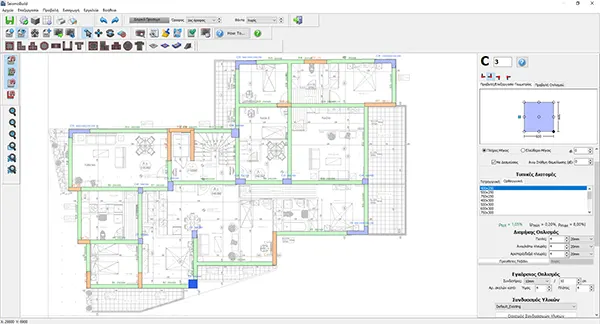
  • With the Building Modeller the user can model real regular or irregular 3D reinforced concrete structures of up to 100 storeys within minutes. It features an easy CAD based (e.g. AutoCAD file) input.

  • Easy input of infill panels and steel braces in the Building Modeller.

  • New 3-sided, 2-sided and 1-sided jackets are available in the Building Modeller.

  • Individual footings, Strip footings and Connecting beams are available for the modelling of foundation within the Building Modeller facility.

  • Twenty one material models, such as nonlinear concrete models, a high-strength nonlinear concrete model, nonlinear steel models, a SMA nonlinear model, masonry models etc.

  • Seventy two (72) section types, range from simple single-material solid sections to more complex reinforced concrete, steel, composite and masonry sections.

  • The applied loading may consist of constant or variable forces, displacements and accelerations at the nodes, as well as distributed element forces. The variable loads can vary proportionally or independently in the pseudo-time or time domain.

  • A large variety of reinforced concrete, steel composite and masonry sections is available.

  • Numerical stability and accuracy at very high strain levels enabling precise determination of the collapse load of structures.

  • SeismoStruct possesses the ability to smartly subdivide the loading increment, whenever convergence problems arise. The level of subdivision depends on the convergence difficulties encountered. When convergence difficulties are overcome, the program automatically increases the loading increment back to its original value.

  • Capacity checks in chord rotation and shear can be performed, according to Eurocode 8 along with the majority of the available National annexes, ASCE 41-17 (American Code for Seismic Evaluation and Retrofit of Existing Buildings), NTC-18 (Italian National Seismic Code), NTC-08 (Italian National Seismic Code), KANEPE (Greek Seismic Interventions Code) and TBDY (Turkish Seismic Evaluation Building Code) in reinforced concrete structures and for all the limit states of the specified codes.

  • Advanced post-processing facilities, including the ability to custom-format all derived plots and deformed shapes, thus increasing productivity of users.

Do you need SeismoStruct just for one project?

Rent a licence and save up to 80%!

Get advance of SeismoStruct Bundle Offers

Get the latest versions of SeismoBuild and SeismoStruct for a discount of 25%!

Completely visual interface. No input or configuration files, programming scripts or any other time-consuming and complex text editing requirements.

Create & Execute thousands of analyses very quickly and effectively

The ‘SPF Creator’ program has been included in the installation. Users can use the program, together with a spreadsheet program like MS Excel, to create hundreds or thousands of SeismoStruct input files very quickly without the need for any programming skill. SPF Creator can be used together with SeismoStruct’s batch program, SeismoBatch, to execute thousands of analyses (e.g. for the derivation of fragility curves) very quickly and effectively.

Seismosoft aspires to make SeismoStruct the most popular finite element analysis software for structural assessment, strengthening, and the design of structural interventions and upgrading.

Licensing

Try our Earthquake Engineering Software Solutions for free by downloading a one month Trial Version*

Get a Commercial License and unleash the full potential of Seismosoft software and access to premium technical support.

Buy 2-5 SeismoStruct Licenses and get 25% discount or a 35% discount for 6 or more licenses!

Get both SeismoStruct and SeismoBuild as a bundle at a 25% discount!

Licenses for Academic Use & Discounts

We offer Academic Versions* with no time limitation for Academic Use to users who are currently enrolled with an academic/research institution. If you are interested in receiving an Academic License, please request it by using the registration module at the start-up of the programs.

Students, Academic Staff and/or Universities may benefit from a 10% discount to all full Commercial versions of Seismosoft products and product bundles.

* The Academic/Trial Version supports code-based checks of up to twenty members and cannot send support email to Seismosoft within the program.

CHOOSE THE VERSION TO DOWNLOAD